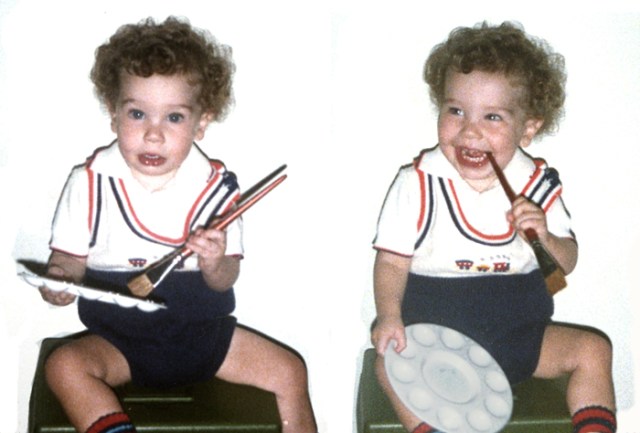
A SOMBER, GRAY SKY DARKENS ABOVE

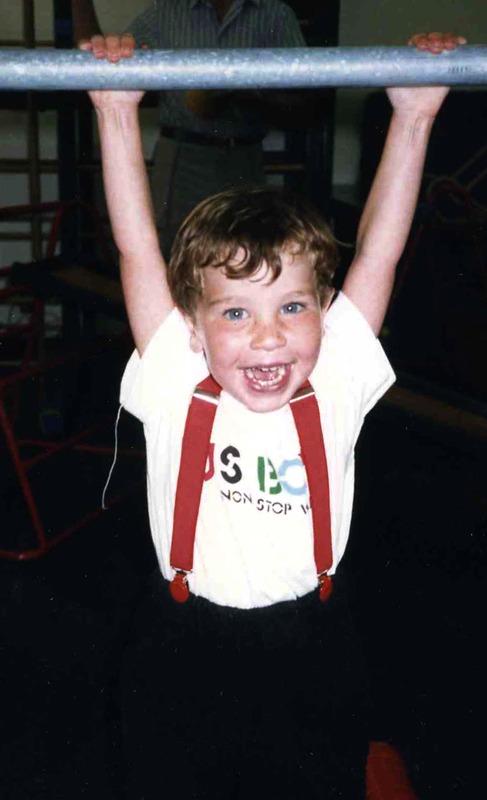
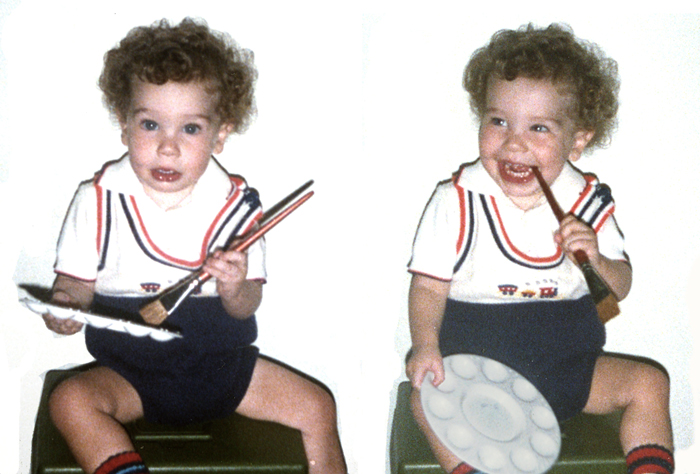
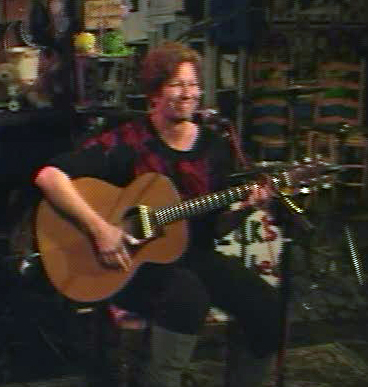
Do I look happy?

I wanted to respond a little further to one of my friend, Sam’s questions. He asked me, “Can grief change you into a better person?”

This actually is similar to a very common theme, which is to make the best out of a terrible situation, to find something good to come out of the “wreckage of grief.”

When I was grieving, I often heard comments and received messages from well-meaning people how “many people go on and do something beneficial” as a result of their grief.

Statements like this contain such a natural and honest wish. After eighteen years on my grief journey, I certainly understand where it is coming from. It is a statement made out of a desire to help someone who is grieving feel better about how they’ve handled their situation.

It is also a logical extension of making sense and giving meaning to something that cannot be explained.

I know this certainly sounds like something that is positive and kind. However, for someone who is in deep bereavement, it is not.

I realize that I’ve written before and explained what is most helpful to someone grieving. I can easily articulate this with the perspective of someone who has suffered with grief.

This message wasn’t comforting for me while I was grieving!

Here is why:

When I was suffering with grief, I didn’t want to hear whether anything “good” came out of any person’s death. At that moment in time, all I wanted was for my son to come back to life!

Feeling that something “purposeful” could come out of his death would be to acknowledge something selfish. I didn’t want to there to be any purpose or benefit to his death! It was inconceivable.

When I was grieving and in my deepest pain, there was only one thing I hoped for besides wishing my child could come back. It is very difficult for me to acknowledge what I consider my greatest achievement.

It would be SURVIVAL. For people who are deeply suffering, that is a huge achievement!

SURVIVAL doesn’t sound like much.

Yes – many people are able to go on and memorialize their loss with great achievements. They might even become a better person as a result of their grief.

But for someone who can barely get through the day, all they want to know is this: How can I survive this pain?

It’s easier to survive the pain when it’s acknowledged for what it is.

It’s more helpful to tell someone grieving how much you realize they are suffering and how sad it is that their loved one is gone. And of course, that’s another opportunity to mention how special their loved one is and was.

Believe me, people who are grieving and suffering would like to know there could be something purposeful from their loss LATER ON – once they’ve processed and accepted that their loved one is truly gone.

For me personally, I am grateful for the beautiful things that have resulted from my eighteen years of pain. For all the many, positive things that came out of Jason’s life and death, I am thankful.

However, I still believe my greatest achievement was my SURVIVAL.

That was the hardest thing of all.

The fact that I can share my experience through writing and music is easy compared with that.

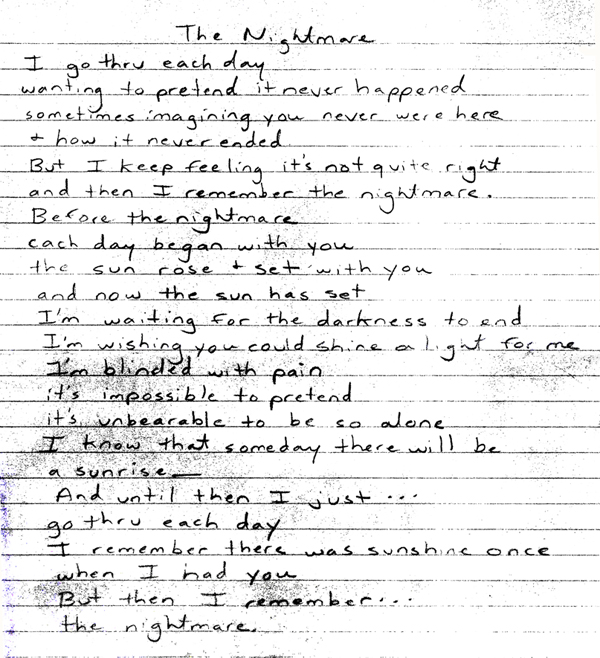
A poem below that I wrote when I was deeply grieving:

The Nightmare

I go through each day

wanting to pretend it never happened

sometimes imagining you never were here

and how it never ended

But I keep feeling it’s not quite right

and then I remember the nightmare.

Before the nightmare

each day began with you

the sun rose and set with you

and now the sun has set

I’m waiting for the darkness to end

I’m wishing you could shine a light for me

I’m blinded with pain

it’s impossible to pretend

it’s unbearable to be so alone

I know that someday there will be a sunrise

And until then I just . . .

go through each day

I remember there was sunshine once

when I had you

But then I remember . . .

the nightmare.


© Judy Unger and http://www.myjourneysinsight.com 2010. Unauthorized use and/or duplication of this material without express and written permission from this blog’s author and/or owner is strictly prohibited. Excerpts and links may be used, provided that full and clear credit is given to Judy Unger with appropriate and specific direction to the original content.

Tagged , , , , , , , , , , , , , , , , , , , | 2 Comments

THE AMPUTATION OF MY SOUL, PART 2

Below is correspondence with my friend, Sam:

Judy, when you said that the grief is like a scar and changes you as a person…does it have to be like a car wreck? Usually a car wreck only makes you worse!  But can grief change you into a better person? Maybe that is the ultimate challenge in dealing with tragedy.

I understand that Compassionate Friends was like a little bandage on a big wound…is there anything that can be done to make the bandage bigger?…Sam

Hi Sam,

Yes, Compassionate Friends was a little bandage on a big wound. And here’s the sad part – some people won’t access the bandage. They are not willing or able to share and listen to others. I think especially, men are more stoic. It wasn’t like we didn’t have men at meetings – there were quite a few. But divorces were ridiculously commonplace. I think the percentage was 95%.

I did think of something that could make the bandage bigger. I have written more for another post.

Judy

Ps. Once again, thanks for your thoughtful questions.

I must preface this by explaining my words I wrote on the prior post:

“I devoted myself to remembering my dead child. I memorialized him by giving all the love in my heart I had for him to my family, to those who were alive in my life – my children, my husband, and my parents.

My bigger bandage was to go on and have more children.

It was not a replacement – there is no replacement ever!

Perhaps this was so important for me – it was the reason that my second post after my blog’s introduction was about this.

I must preface my message by saying that this was my personal choice. This belief is mine and no one else’s!

I originally hesitated to share this because there are people who have lost a child and cannot consider this option. However I’ve decided to share it because there is a message that I believe is applicable to anyone grieving and that is my goal!

My message is this:

I was able to honor the memory of what I’d lost, by giving all my love to others.

A good friend of mine adopted a stray kitten after her beloved cat of twenty years died. She did not do it immediately.

I think that is a good example of what I am suggesting.

As far as the analogy to a “car wreck” goes, unfortunately deep grief wrecks lives.

I believe there is a sense of unfairness to the loss of someone who didn’t get a chance to live a full life (and that includes an infant, stillbirth, and miscarriage). Everyone dies, but when it happens before someone even had a chance to experience a full life – perhaps that is where so much of the sadness lies.

However, there is certainly grief with losing anyone, even someone older.

I have grieved for other things in my life besides the death of my son. With autism, there is also the issue about unfairness for the additional hurdles in life.

However, I never want my scars to define me.

Coping with those scars were easier for me when I became less focused on why the accident happened and more focused on how I could compensate and adjust.

Unfortunately, like a car wreck – accidents happen. And there are no seatbelts for grief either!

There was a reason that I named this Post “The Amputation of my Soul – Part 2”

I plan to share my grief writing here word for word. It describes exactly how I felt after the death of my child.

(I don’t know when this was written)

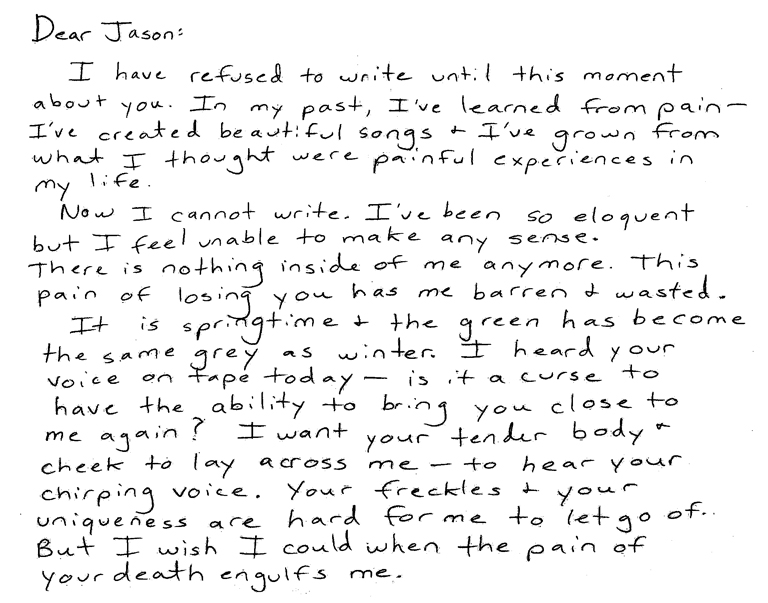
Dear Jason,

I have refused to write until this moment about you. In my past, I’ve learned from pain – I’ve created beautiful songs and I’ve grown from what I thought were painful experiences in my life.

Now I cannot write. I’ve been so eloquent but I fell unable to make any sense. There is nothing inside of me anymore. This pain of losing you has me barren and wasted.

It is springtime and the green has become the same grey as winter. I heard your voice on tape today – is it a curse to have the ability to bring you close to me again? I want your tender body and cheek to lie across me – to hear your chirping voice. Your freckles and your uniqueness are hard for me to let go of. But I wish I could when the pain of your death engulfs me.

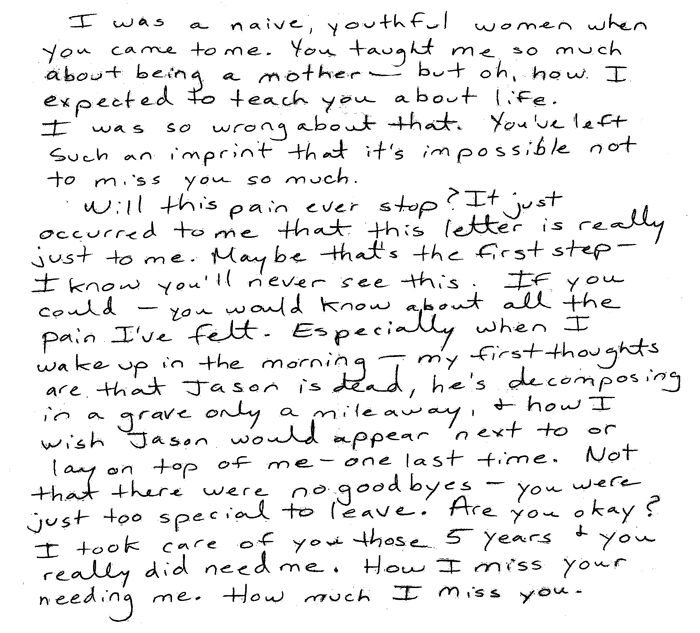
I was a naïve, youthful woman when you came to me. Your taught me so much about being a mother – but oh, how I expected to teach you about life. I was so wrong about that. You’ve left such an imprint that it’ impossible not to miss you so much.

Will this pain ever stop? It just occurred to me that this letter is really just to me. Maybe that’s the first step – I know you’ll never see this. If you could – you would know about all the pain I’ve felt. Especially when I wake up in the morning – my first thoughts are that Jason is dead, he’s decomposing in a grave only a mile away, and how I wish Jason would appear next to or lay on top of me – one last time. Not that there were no goodbyes – you were just too special to leave. Are you okay? I took care of you those 5 years and you really did need me. How I miss your needing me. How much I miss you.

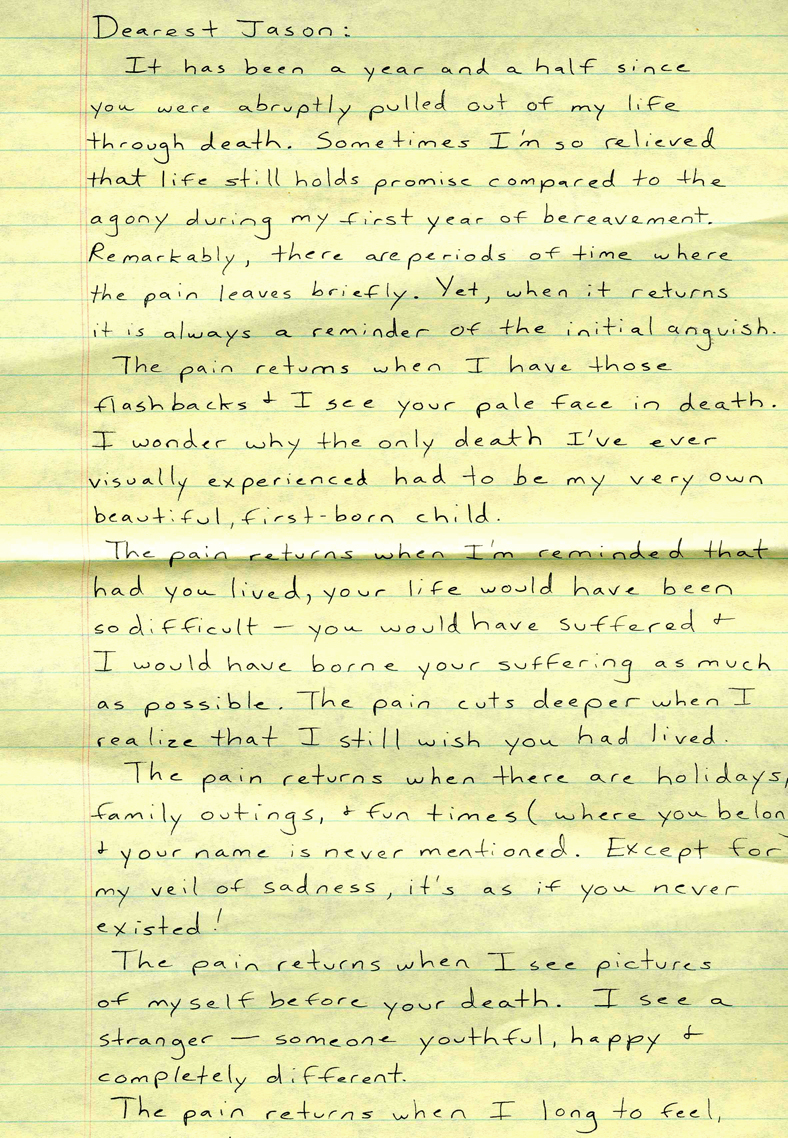
This letter below was written a year and a half after my son died.

Dearest Jason,

It has been a year and a half since you were abruptly pulled out of my life through death. Sometimes I’m so relieved that life still holds promise compared to the agony during my first year of bereavement. Remarkably, there are periods of time where the pain leaves briefly. Yet, when it returns it is always a reminder of the initial anguish.

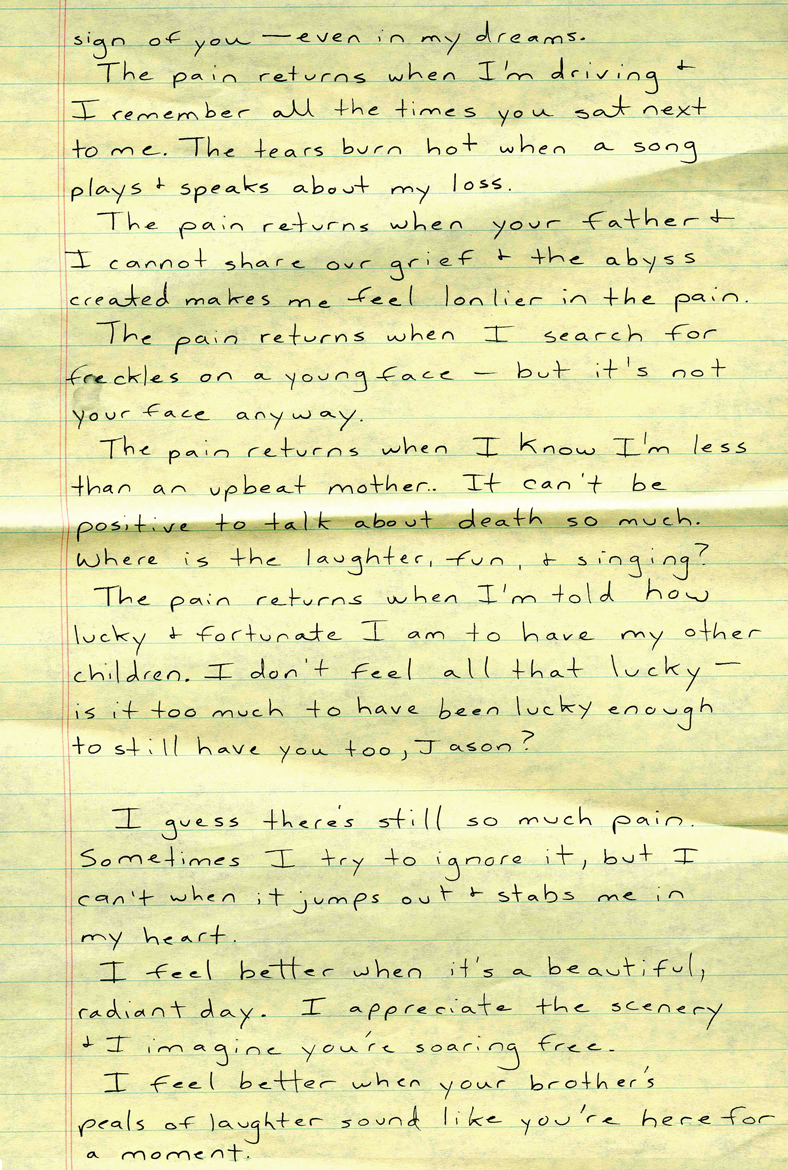
The pain returns when I have those flashbacks and I see your pale face in death. I wonder why the only death I’ve ever visually experienced had to be my very own beautiful, first-born child.

The pain returns when I’m reminded that had you lived, your life would have been so difficult – you would have suffered and I would have borne your suffering as much as possible. The pain cuts deeper when I realize that I still wish you had lived.

The pain returns when there are holidays, family outings, and fun times (where you belong), and your name is never mentioned. Except for my veil of sadness, it’s as if you never existed!

The pain returns when I see pictures of myself before your death. I see a stranger – someone youthful, happy, and completely different.

The pain returns when I long to feel, smell, and hear you. But there isn’t a sign of you – even in my dreams.

The pain returns when I’m driving and I remember all the times you sat next to me. The tears burn hot when a song plays and speaks about my loss.

The pain returns when your father and I cannot share our grief and the abyss created makes me feel lonelier in the pain.

The pain returns when I search for freckles on a young face – but it’s not your face anyway.

The pain returns when I know I’m less than an upbeat mother. It can’t be positive to talk about death so much. Where is the laughter fun, and singing?

The pain returns when I’m told how lucky and fortunate I am to have my other children. I don’t feel all that lucky – is it too much to have been lucky enough to still have you too, Jason?

I guess there’s still so much pain. Sometimes I try to ignore it, but I can’t when it jumps out and stabs me in my heart.

I feel better when it’s a beautiful, radiant day. I appreciate the scenery and I imagine you’re soaring free.

I feel better when your brother’s peals of laughter sound like you’re here for a moment.

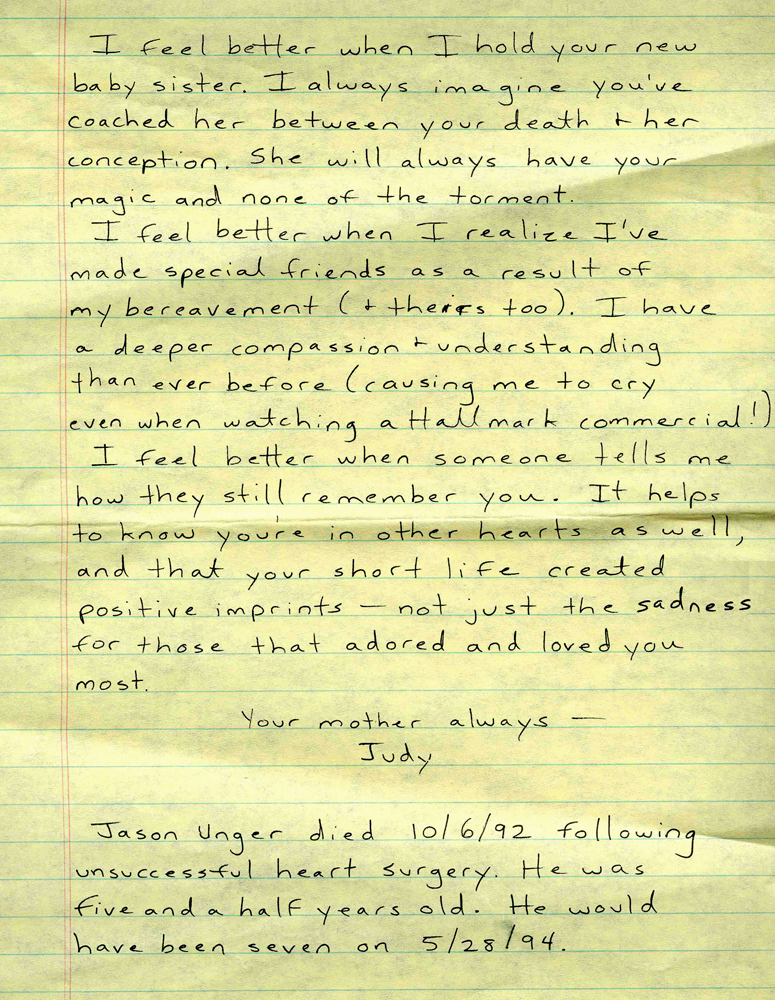
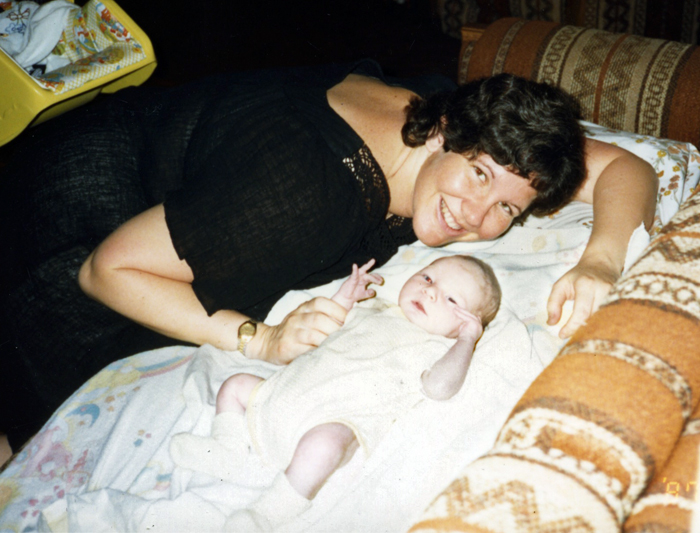
I feel better when I hold your new, baby sister. I always imagine you’ve coached her between your death and her conception. She will always have your magic and none of the torment.

I feel better when I realize I’ve made special friends as a result of my bereavement (and theirs, too). I have a deeper compassion and understanding than ever before (causing me to cry even when watching a Hallmark commercial!)

I feel better when someone tells me how they still remember you. It helps to know you’re in other’s hearts, as well, and that your short life created positive imprints – not just the sadness for those that adored and loved you most.

Your mother always, Judy

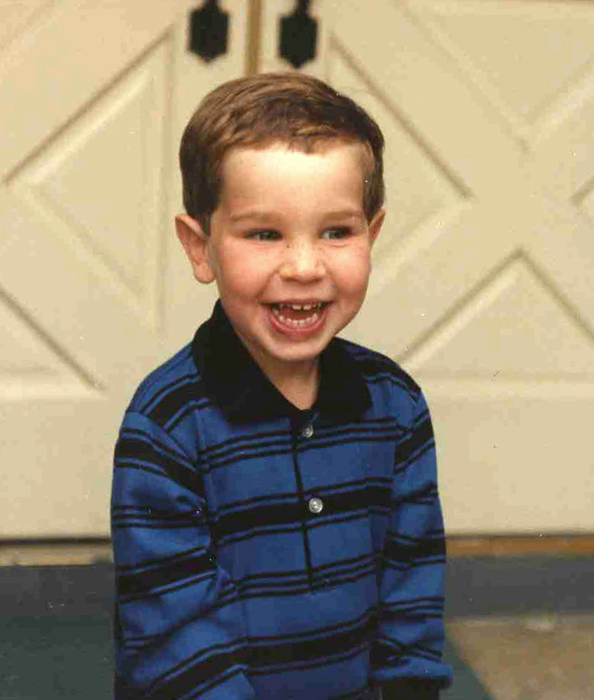
Jason Unger died 10/6/92 following unsuccessful heart surgery. He was five and a half years old. He would have been seven on 5/28/94.


© Judy Unger and http://www.myjourneysinsight.com 2010. Unauthorized use and/or duplication of this material without express and written permission from this blog’s author and/or owner is strictly prohibited. Excerpts and links may be used, provided that full and clear credit is given to Judy Unger with appropriate and specific direction to the original content.

Posted in Grief Educational | Tagged , , , , , , , , , , , , , , , , , , , | 1 Comment

WAITING FOR SOMEONE TO EASE MY PAIN INSIDE

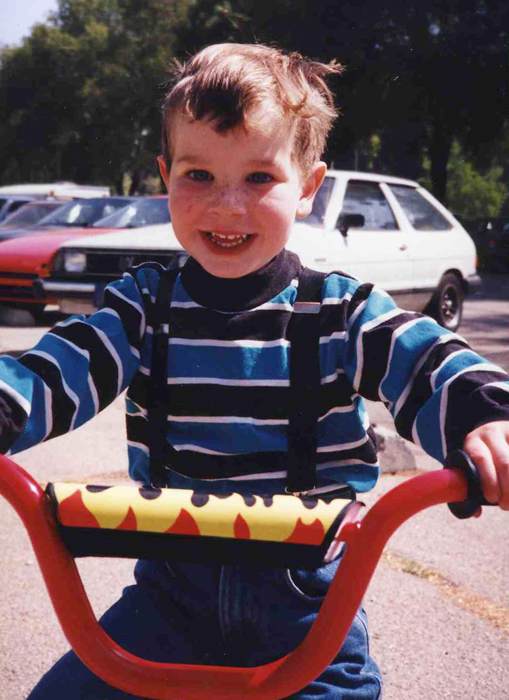
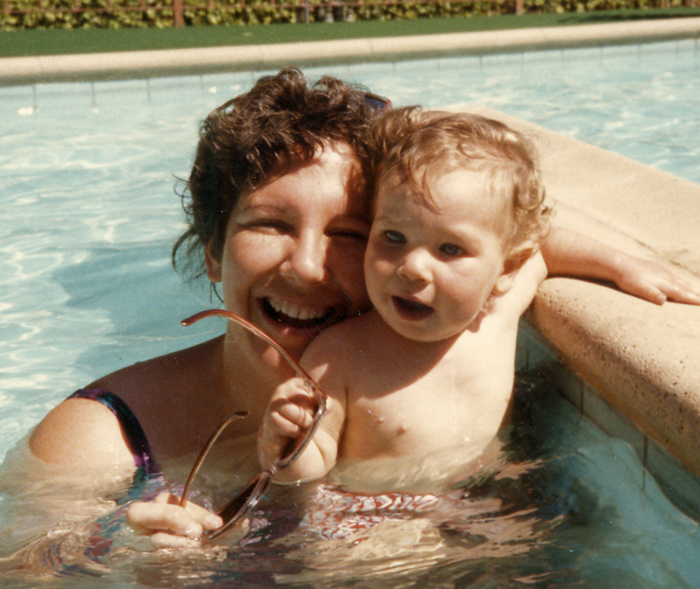
Baby Jason on the couch

I wondered if I was being honest with myself. Was the pain really less after eighteen years? I’ve been writing about the most painful part of my life; how could that not affect me?

I decided that writing about my grief has really connected me to life and given me so much purpose.

I felt ready to move on, but Sam still had more questions for me. As I tried to be more clear and explain my views about grief, I found so much more clarity and insight.

On Dec 15, 2010, Sam wrote:

Judy,

I read your last post…very painful, yet clear!…but I’m maybe even more confused. It would seem you are saying that nothing made much of a difference for you while you were grieving…not support, not community, not groups, not individuals (except your Mom). But, you were actively involved in Compassionate Friends. Just wondering why? Are they helpful for others, but just not particularly for you? In a sense, Compassionate Friends is a community. But is it helpful to be in a grief community? Is it that grief simply is something has to be lived through and worked through on one’s own…some get to the other side, and some don’t?

And by the other side, I don’t mean that grief ends….I mean a side where life can become enjoyable again. Is there anything that will help someone overwhelmed by grief? You mentioned that Judy Present would have told Judy Past that she will sing again…but could Judy Present have told Judy Past how to sing again, how to get her life back sooner? Have others found the path sooner? Or are they just suppressing their feelings?…Sam

Hi Sam,

I’m wondering if I’m an adequate communicator – you are absolutely right! At the same time that I’ve said “I’ve felt so alone,” I was involved with Compassionate Friends.

“Community support” actually did help me survive. I highly recommend it, and I have from the beginning.

Thanks again for pointing this out. I’m going to address it further.

Judy

Going to a Compassionate Friends meeting was a place to voice my sadness. Not only did I voice my sadness, I listened to the sadness of others! Sometimes that was extremely hard, too. That’s why groups are not for everyone. For people who are more “private” – it doesn’t help! My husband hated going, for example.

A support group did ease some of the anguish of my grief. The resulting friendships most certainly helped, but not enough to really change the pain of what it was.

My Involvement consisted of a breakfast once a week and a meeting once a month. However, I experienced the pain of grief every waking moment and cried enough tears to fill an ocean.

I don’t want to send a mixed message. So here is a summary and I hope it makes sense:

1. Grief is like an amputation. Lifeblood from the soul flows out, and no one can help initially. There is shock, numbness, and disbelief.

2. Receptivity to seeking support is very individual.

For me it was immediate. I needed to know if anyone could survive this level of pain. I was desperate to find someone with similar circumstances; I searched everywhere I could and attended many support group meetings. After a short time in a “general bereavement” group, I began to only attend those for parents who had lost children.

I did not find anyone that counseled me – my first “therapist” had a second child die before she could significantly counsel me. I saw a few therapists, but felt that they didn’t have a clue about my grief. I became a leader at Compassionate Friends within a short time because there was no one else who was willing, and I did this while I was still newly bereaved.

It really did help me to feel I wasn’t alone with my pain because I saw others suffering, too. There became a time in my bereavement where I saw others in so much pain, that I became grateful to know I had progressed to feeling better. This was about five years after my son’s death.

What would I tell someone deeply grieving about finding happiness again? That is very hard for me to answer, but I will try.

I am going to try to answer this as if I were speaking to myself when I was in my “deepest pain.”

I was not receptive to hearing about purposeful things that came from someone’s loss. I was dealing with trying to cope with losing what I loved so much and no one could convince me that anything “good” could come from it.

I was not receptive to hearing about “people who had recovered” from their grief. First off, I didn’t believe it was true. I was also certain if they had recovered, that they didn’t have the attachment I did.

So I would never say, “Look at me – I’ve recovered and I’m happy!”

If I told Judy of the Past that she would someday sing again, it would only work if I told her this:

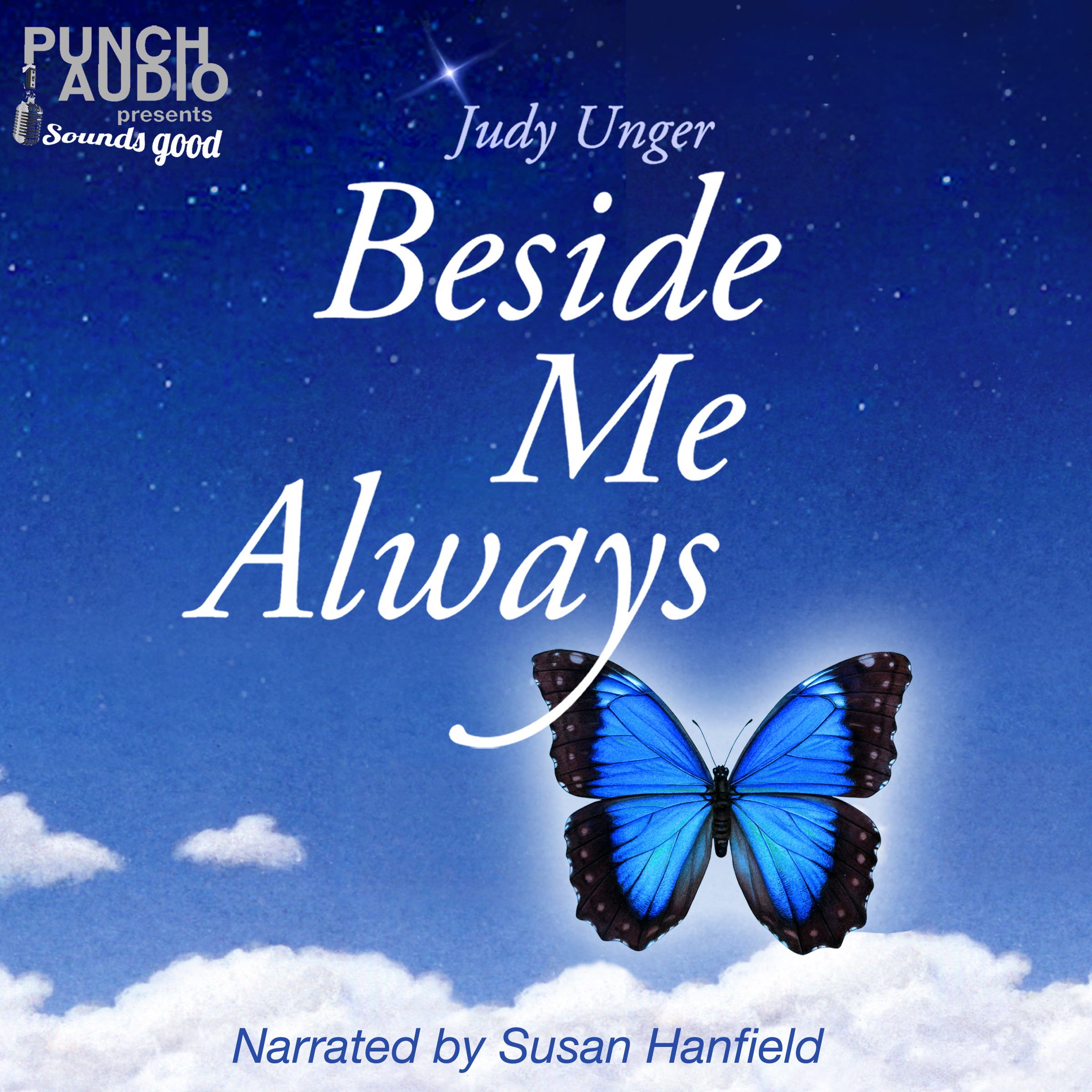
“Beside Me Always” is a wonderful legacy for Jason that became possible after being unable to sing for such a long time!

I would also say, “The pain of grief you are experiencing is absolutely horrible. It is worse than anyone can imagine. I have no idea how much pain you are in. I am not going through what you are going through. I wish I could help, and if you think I could help – ask me anything! I will tell you what helped me, although it is different for every human and it might or might not help you.

Now I will write about what helped me survive my terrible pain.

I devoted myself to remembering my dead child. I memorialized him by giving all the love in my heart I had for him to my family, to those who were alive in my life – my children, my husband, and my parents.

I devoted myself to comforting other people suffering because it was in my child’s memory.

I committed myself to staying married, despite the challenges and abyss that was created by grief.

I set no timetable. I did not go around grief; I went through it. I cried and I allowed myself to feel the pain. I would never tell anyone grieving that there is a way to recover and find happiness “quicker.” First off, I believe it is elusive when it is sought – it is not a goal, but a by-product.

For me, survival was the key. There are many people that cannot survive the pain of grief!

I did all of those things, except for one thing that held me back from finding joy.

I didn’t feel that my happiness was important or even possible.

I was so busy surviving that I forgot how to enjoy life.

7:00 p.m.

My office was quiet and I decided instead of editing, I would scan many of those recent papers I found in an old “grief folder.”

It was unbelievable for me to read words that I had written so many years ago. Only six months ago I had completed the lyrics for my song “So Real.” There on one of those pages were my words:

“I imagine your soul soaring free.”

I saw so many things that brought me back, but I had no tears. I simply had deep thoughts about how to explain the process of my “healing.”

I found two pages that were very interesting. I had actually done more than sing a song at my friend, Linda’s funeral. I spoke and my pages said that before she died she had asked me! I didn’t remember that.

My funeral speech said many of the same things I just wrote about. I plan to add those words to: Post #170 When You’ve Left You’ll Still Be With Me.

Then I saw another very interesting paper. It was from a woman who wrote about me to Becky. Becky became the leader of our local, Compassionate Friends chapter after I stepped down.

On that paper was a phone number. The woman’s name was Charlene. That paper was at least fifteen years old.

Impulsively, I decided to call the number. A woman answered the phone and knew who I was!

We had a wonderful conversation. It was another one of those amazing coincidences in my life. Charlene remembered me for all of my writing contributions to Compassionate Friends newsletters. We had never met. But, she also knew about me through the brother of my close friend, Cheryl, who died two years ago!

I was able to tell her, “Those songs I wrote when I knew Cheryl, have brought me so much joy at this time in my life!”

After I hung up, I decided that community support actually had made a huge difference for me. It wasn’t simply about my search to find someone to support me. It was about my wanting to help others with their grief; that was something that had actually helped me from the very beginning. That was why I had gone to help Lori when I was only in my second year of bereavement!

There was no doubt that anyone who had also experienced grief had the ability to quickly connect with my feelings.

This “club of bereaved parents” that I belong to might never have been one I planned on joining, but it certainly made my grief journey far less lonely for me.

Perhaps people in the past had this all around them. Perhaps what Sam had said was true.

Charlene told me she had a grief partner in Canada whom she still spoke with on the phone every Monday evening!

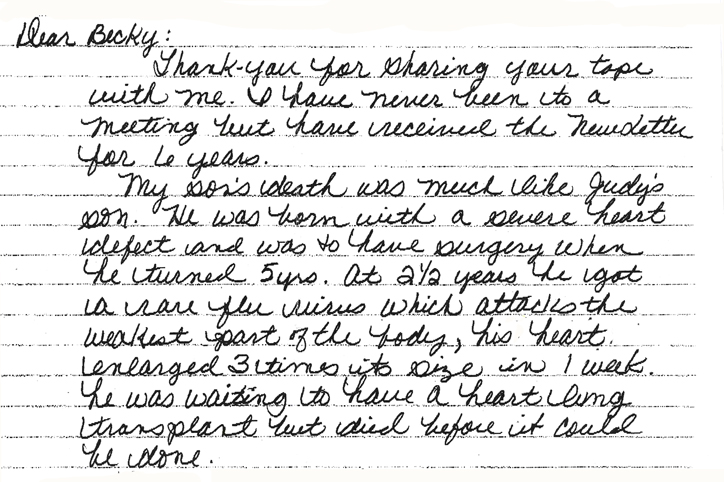
Below is Charlene’s letter. It tells the story better than all of my prior writing.

Dear Becky,

Thank you for sharing your tape with me. I have never been to a meeting but have received the Newsletter for six years.

My son’s death was much like Judy’s son. He was born with a severe, heart defect and was to have surgery when he turned five years. At 2 ½ years he got a rare flu virus which attacks the weakest part of the body, his heart enlarged 3 times it’s size in one week. He was waiting to have a heart lung transplant but died before it could be done.

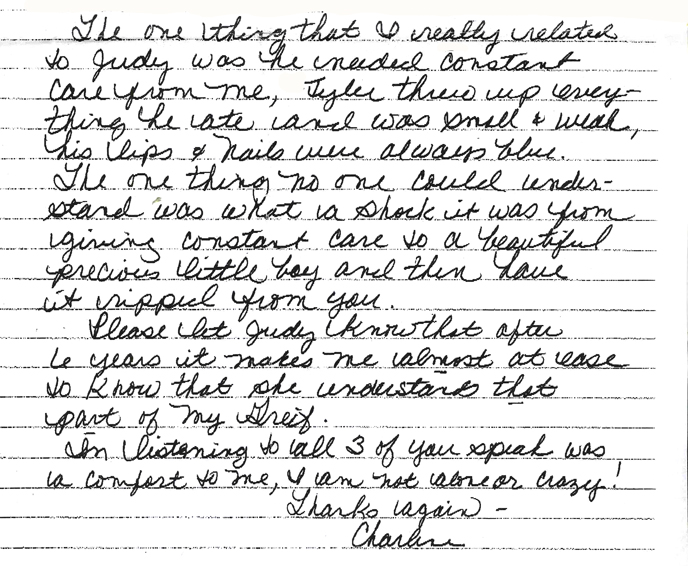
The one thing that I really related to Judy was he needed constant care from me. Tyler threw up everything he ate and was small and weak. His lips and nails were always blue. The one thing no one could understand was what a shock it was from giving constant care to a beautiful, precious little boy and then have it ripped from you.

Please let Judy know that after six years it makes me almost at ease to know that she understands that part of my grief.

I’m listening to all three of you speak. It was a comfort to me; I am not alone or crazy!

Thanks again, Charlene


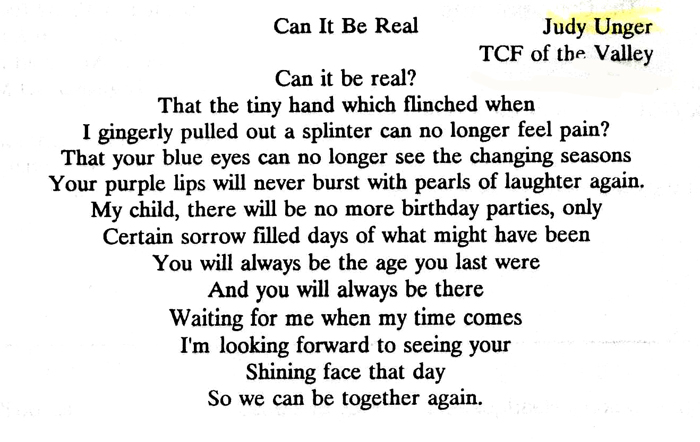
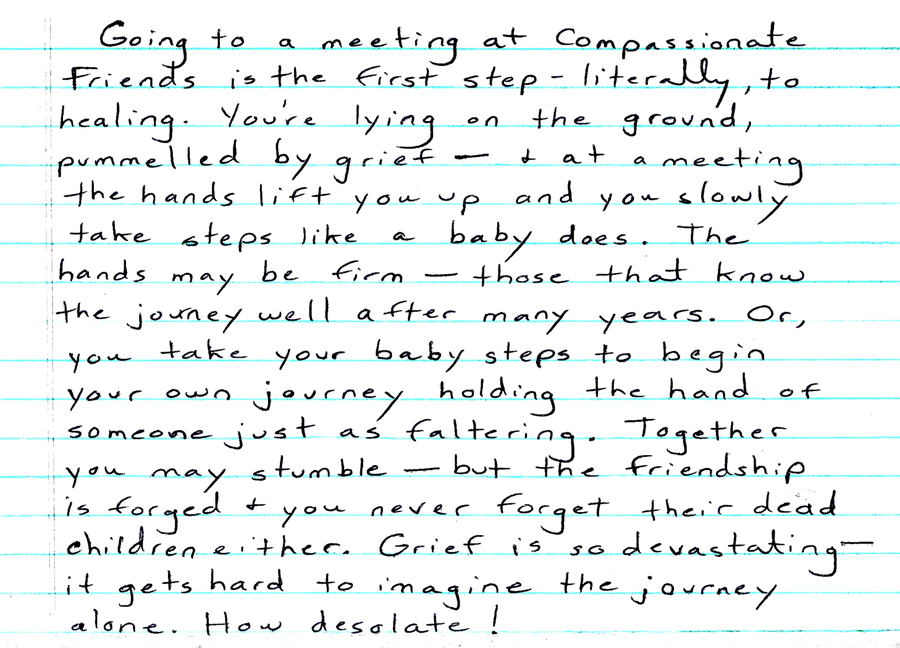
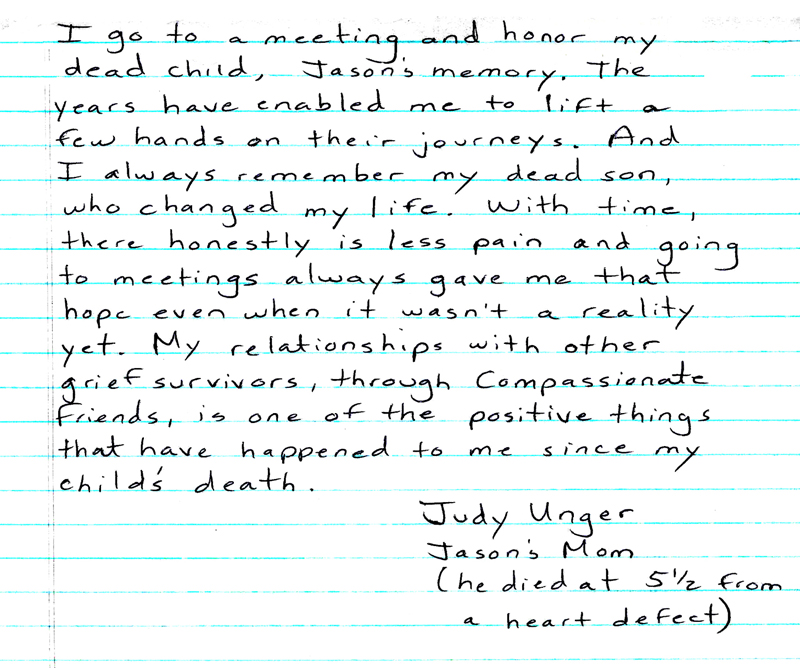
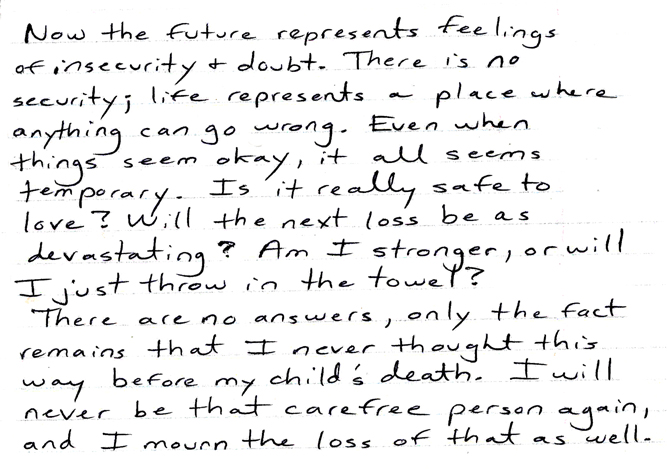
Below is another page I found. This page also spoke to my finding support while I was grieving. I did not read these words until after I wrote this post. This was written at least fifteen years ago.

Clicking on this makes it larger.

© Judy Unger and http://www.myjourneysinsight.com 2010. Unauthorized use and/or duplication of this material without express and written permission from this blog’s author and/or owner is strictly prohibited. Excerpts and links may be used, provided that full and clear credit is given to Judy Unger with appropriate and specific direction to the original content.

Posted in Grief Educational | Tagged , , , | Leave a comment

THE AMPUTATION OF MY SOUL, PART 1

I am continuing to write more about grief.

I remember grief well, but I am not bleeding anymore.

It is important to share that I do not feel anguished as I write about grief. Eighteen years have gone by since my son died. The agony did subside after ten years. I had no feelings at all for a long time after that – no pain, nor joy.

It was only this year that I discovered joy again.

When I was deeply grieving, I felt no one could understand my pain.

Yesterday, I remembered some lyric lines from my song, “Through My Music.”

“Through my music I forget, all the time I’ve wasted

Waiting for someone to ease my pain inside”

It is fascinating for me that I wrote such eloquent songs about grief before I ever experienced it.

Currently, I believe the world is full of grieving people who are terribly suffering.

For anyone grieving, the fact that I can sing and be joyful again might be unbelievable for them.

It was for me once!

People, who are in deep grief, probably cannot grasp that I grieved as deeply as I did.

It is only now at this juncture that I’ve realized how much I’ve learned through my grief journey. It is far less lonely for me now.

Once again, I speak about grief from my own, personal experience. I have connected with a lot of bereaved people since my loss, and many of them feel the same way and of course, some do not. All people are different.

“An amputation of my soul”

I really could describe my grief as an amputation of my soul.

It was not visible, but it left scars that are there FOREVER. For me, healing is actually an appropriate word to apply to grief. Healing implies a wound, and with wounds there are scars.

With my joy, I have chosen at this juncture to look at my scars in a positive way:

My scars allow me to understand how other people feel who are bleeding.

My scars allow me intense appreciation for my survival.

Through the grief process, I’ve compensated for the missing part of my soul. I adjusted and learned to live with it. It is process that will continue for the rest of my life.

I am writing as a response to a message from my friend, Sam. Here is an excerpt:

“I do think that a strong support system makes a big difference in coping with such a tragedy…it may be that only those that have had a similar loss can truly be supportive…but I am thinking that the support and sensitivity of those that haven’t had a loss of such magnitude is also vital…maybe its the insensitivity of the larger group that creates a need for organizations like Compassionate Friends.”

As far as coping with “insensitivity,” I believe that when I was “bleeding” I was in too much pain to appropriately interpret sensitivity. Simple, well-intentioned statements such as, “time heals,” actually upset me!

I really didn’t encounter too much thoughtlessness. I have always been fairly careful about who I’ve kept in my vicinity.

A “strong, support system” was certainly helpful; there was no doubt about that. But alleviating the pain of grief was not possible for me from any other human. Compassionate Friends existed for me as a place to voice these feelings; it was a place to express the sadness.

In Sam’s message to me, he insisted, “People in the past coped better with losing a child than people in the present; for a myriad of reasons. Here is an excerpt:

“I don’t remember the older members of my family or my wife’s family being burdened with profound sadness. In 1900, 11% of children born in the US died before their first birthday (today it is only 0.7%). Yet I have not seen any stories or writings that indicate that the members of that generation were exceedingly sad or troubled by grief. Maybe it was just a different time…no therapy or drugs, and there was a day-to-day concern for survival. But, I believe that the strong support available in communities that were much closer knit and involved with each other than they are today was really the key difference that made coping with tragedy easier.”

Of course, neither of us truly knows what other people from that past felt. The cliché of “appearances can be deceiving,” definitely applies here for me.

I will explain again why I do not believe that statement.

When my soul was amputated, it was my lifeblood that was pouring out.

If the entire population of this planet came to offer comfort, my lifeblood would have continued to pour from me.

I believe that with the “amputation of my soul” there was truly nothing that could stem the flow!

I have said before that I have lived all of the “stages” of grief. In my depressed stage, I was in bed and under the covers – there was no person who could comfort me there, certainly not my husband!

When I was angry, I didn’t want anyone there to comfort me. I told everyone to “leave me alone.”

My mother was probably my closest comfort. That is one reason why I’ve been so sad about losing her incrementally to dementia.

Once again, I don’t want to stop anyone from offering support or kindness to a friend or relative who is grieving. Other people’s caring was always appreciated!

However, I felt I had to reply to the idea that community support made grief “significantly” easier for humans in the past; that it alleviated their pain. It simply couldn’t alleviate mine.

I actually had tremendous, community support when my son died. We had meals brought to our home for months. I am forever grateful for the support I received.

However, with all of that support, my pain was still intense!

I wrote the words that a bereaved mother once told me it took her “seven years for her agony to subside.”

I highly suspect that intense, community support could possibly last that long.

There are also many people who are like my husband. He did not want community members “hanging around” for support. He did not want to talk about his grief, nor discuss it with anyone!

He did not want to be in a support group!

He was still scarred by his grief, but never speaks of it. Therefore, anyone who might meet him could say, “Wow, he has coped well!”

He may appear to have coped well, but his grief journey was as lonely as mine – even though I sought out support.

For these reasons, I do not believe grief was any different for anyone in any period of human history.

My discussion with Sam continued:

On Dec 14, 2010, Sam wrote:

Judy,

In 1900, 1 out of 8 women died during childbirth (at some point in their lives).  So, there was much more death that was experienced by an individual…and I think, based on what you have written, that you would expect that the grief in most communities would have been unimaginable.  And you point out that there was probably more stoicism, more silence.  But you would think that somewhere in our relatively recent history, such grief would have been documented in stories, theatre or music.

But, I don’t remember seeing or learning anything about it…maybe its there and I’m just unaware of it…but I really think there must have been a fundamental difference in how grief was experienced a century ago, and I think it is directly related to societal differences, including more religiosity, obligation, and sense of support within the community.  I believe that grief experiences have changed throughout our history, and the reason I keep coming back to this, is perhaps we can learn something from the past that we can apply to supporting those who are presently in need.

…Sam

My reply:

Hi Sam,

I wrote a lot about this yesterday. It was actually very thought provoking for me. I do not want to appear arrogant. I have to admit, I felt like I had a better perspective on this as a bereaved parent. But I readily admit that I have not researched this or even looked to see what people have written about grief and loss in the past. So actually, I am not qualified to address this at all!

However, even reading what you wrote just now, still does not have me convinced. If I could summarize my feelings it would be this:

I believe what you are expressing is that people coped better because they were better prepared. Death was a part of life and therefore, grief was something that was easier because it was familiar and everyone was supportive.

Here is my personal, view as a parent whose child died.

I have met bereaved parents who were religious and non-religious. They all have suffered!

I knew my child was very sick. I knew he wouldn’t live a long life. I was prepared to lose him so many times and again when I scheduled his surgery. In the past, perhaps it was expected to lose children. Well, I fully expected to lose mine. (This was intuitive; I never expressed it and tried to be positive). I was also in a cardiac child support group. Did it help me to see how other people coped with their child’s death? Not really.

So with all that preparation and knowledge that I would lose my child ahead of time, I was not prepared to deal with my grief. I don’t believe it helped me cope one iota better.

Yes it’s true; medical science made it harder by giving me hope. It might appear that it would have been easier for me if my child had died at birth. I used to think that way, but now I realize that it still would have been terribly painful (as many grieving parents would attest to).

When I’ve dealt with bereaved parents who experienced the “sudden death” of their child – it made me appreciate my time to “say goodbye” to my child, although I hated the disease.

I cannot imagine that if I were born hundreds of years ago without the benefit of medical science that I would have felt differently about this.

I remember elderly, wise and experienced, bereaved people trying to comfort me.

Once again, this is not just about death or medicine. This is about losing a piece of your soul when you say goodbye to someone you love forever.

I am not unusual. I don’t want to be a “poster child for grievers,” just because I have met so many people like myself.

Of course, I wouldn’t know about those people from centuries ago. But I know they were human, too.

Judy

Sam’s message included this:

“I think that there are quantitative differences in grief.  Even though you don’t like to compare, the anguish that people who have lost a child have experienced is far greater than what I have seen in the many patients and friends that have lost a parent.”

Yes, It could be true that the loss of a child creates more anguish. I can hardly believe what I am going to write below, because I used to be the most “grief centric” person on earth!

However, because I have seen a lot of anguish from other, grieving people – that statement is completely unimportant for me now.

I have witnessed tremendous anguish even if it wasn’t as “debilitating” as the loss of my child.

I have met a lot of siblings and grandparents who have suffered terrible losses. I have a good friend who still suffers over the loss of her life partner and another friend still mourning her mother. It might be many years later, but their lives are forever altered.

Their grief was also about an amputation to their soul and left scars.

There simply is no point for me anymore to imagine that my grief is deeper than theirs.

Grief is real, painful and very lonely.

Here are my truths:

There will sometimes be thoughtless remarks made by those who “don’t understand” what grief feels like.

There will often be kind, compassionate gestures made by those who want to understand and to help.

But in the end, grief is probably the loneliest journey a human faces when they lose someone they love.
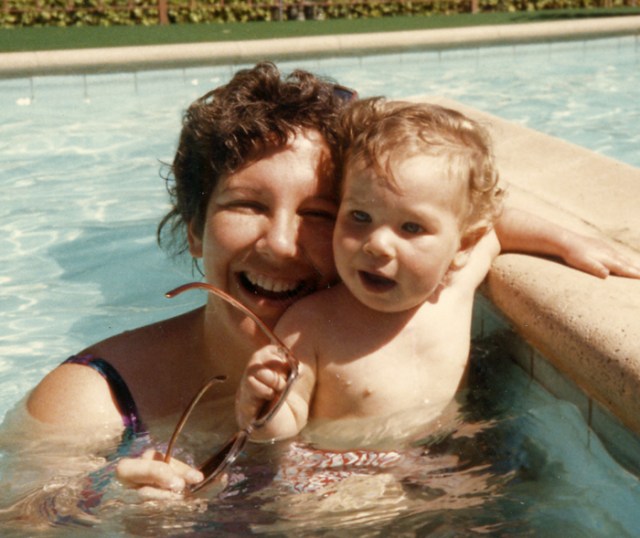
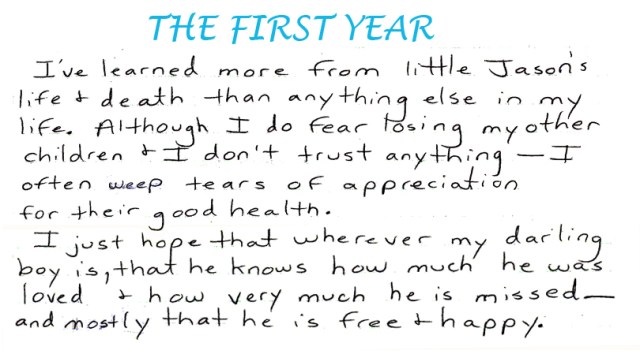
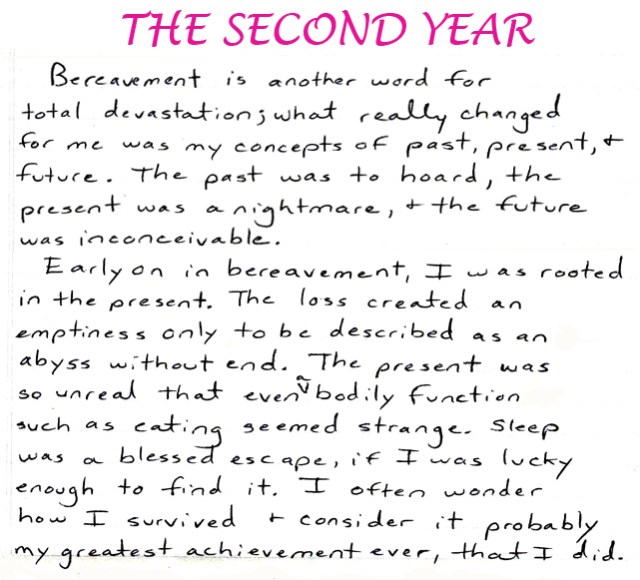
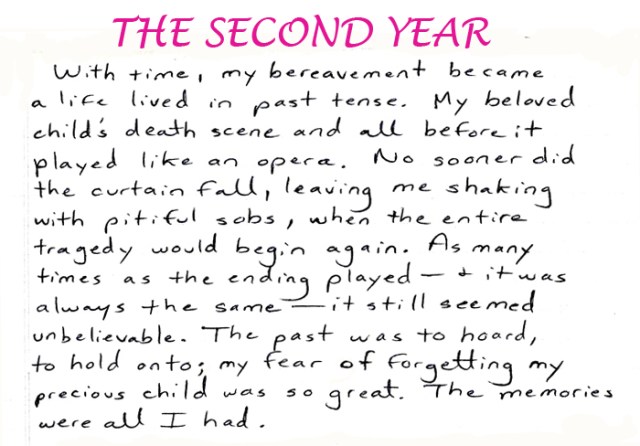
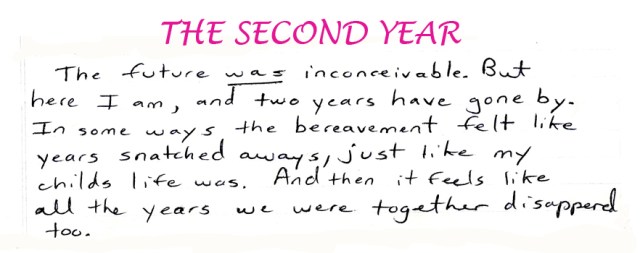
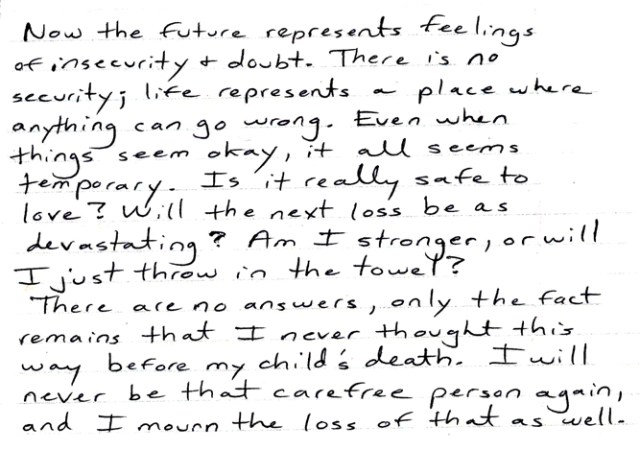
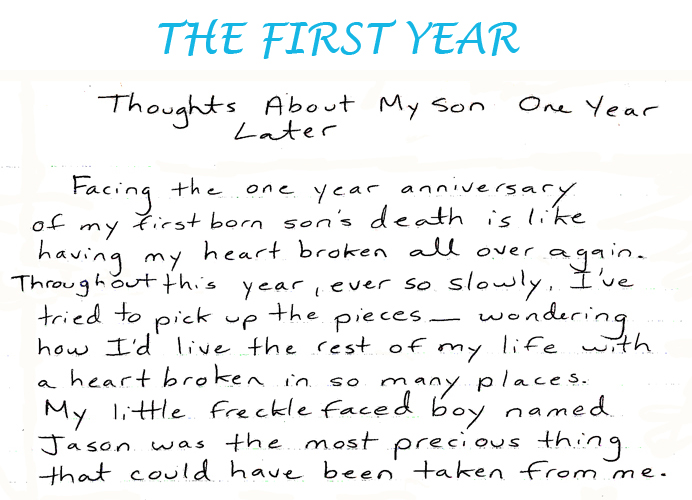
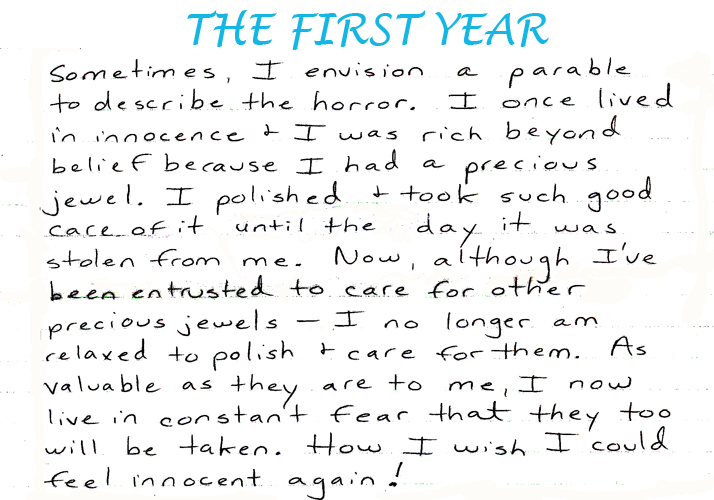
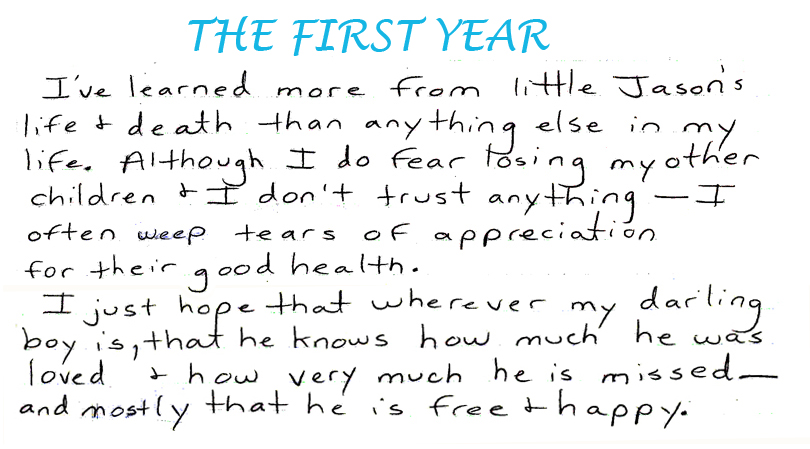
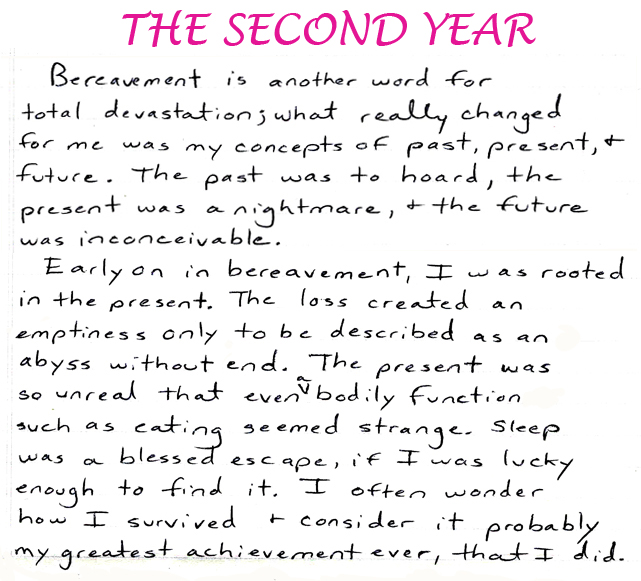
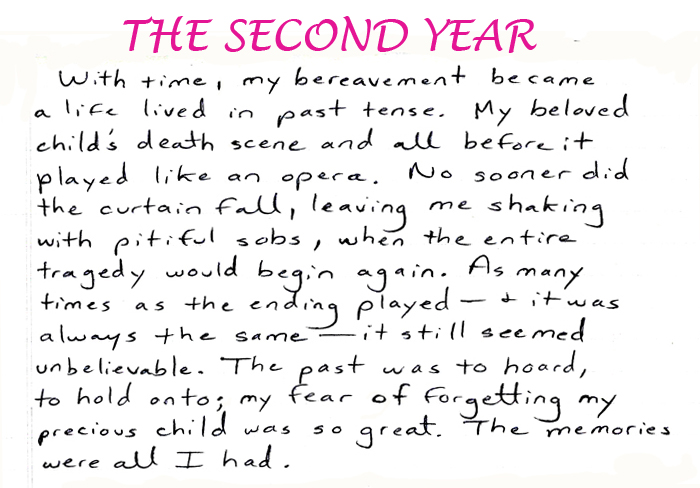
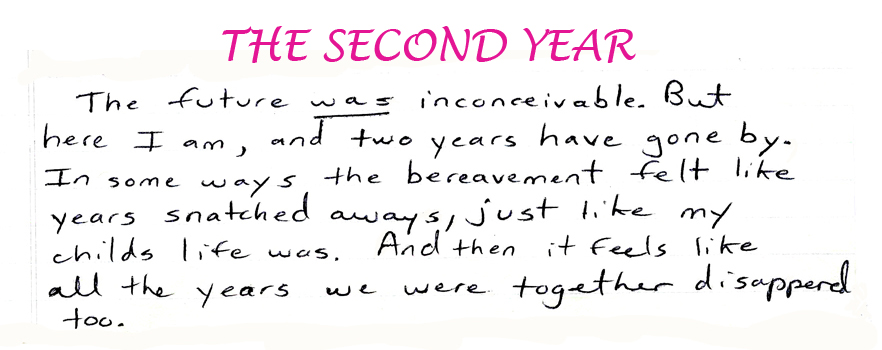
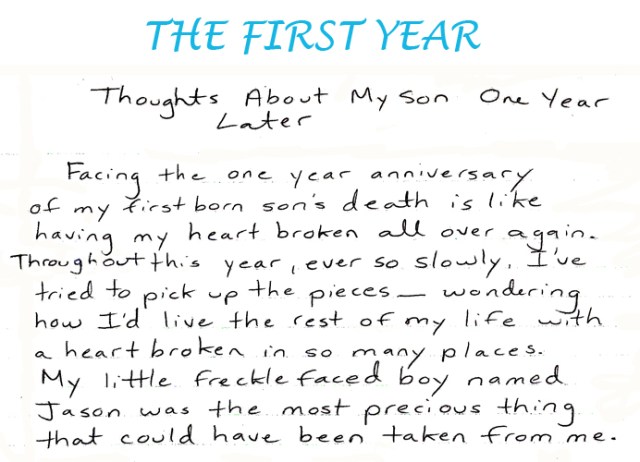
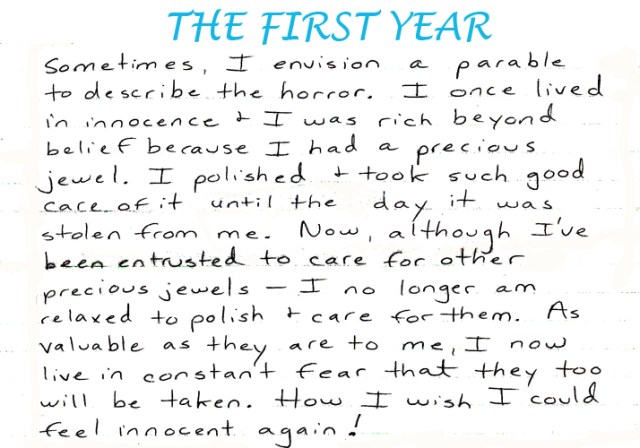
I AM NOW GOING TO SHARE THE WINDOW INTO THE AMPUTATION OF MY SOUL WITH THE WORDS I WROTE AFTER MY FIRST AND SECOND YEAR OF BEREAVEMENT.
© Judy Unger and http://www.myjourneysinsight.com 2010. Unauthorized use and/or duplication of this material without express and written permission from this blog’s author and/or owner is strictly prohibited. Excerpts and links may be used, provided that full and clear credit is given to Judy Unger with appropriate and specific direction to the original content.

Posted in Grief Educational | Tagged , , , , | Leave a comment